Paying around €78 (roughly $85) for a round-trip cable car ticket is enough to make anyone hesitate at the ticket counter in Chamonix. Yet on a clear morning, the Aiguille du Midi is easily one of the most remarkable mountain experiences in Europe.
Unless you have the technical mountaineering skills, crampons, and lungs to climb in the high Alps yourself, this is the closest you will ever get to the icy upper world of Mont Blanc. In just twenty minutes, a two-stage cable car hauls you from the pine forests of the valley floor at 1,035 meters straight onto a jagged granite needle at 3,842 meters (12,605 feet). Up here, you aren’t looking up at the mountains—you are standing eye-to-eye with 4,000-meter peaks, watching roped-up alpinists step out onto narrow snow ridges right below your feet.
The Two-Stage Ascent: Nearly 2,800 Vertical Meters in 20 Minutes
When the Aiguille du Midi cable car first opened in 1955, it held the world record for the highest vertical ascent for decades, and the engineering still feels slightly surreal today.
- Leg 1: Chamonix (1,035 m) to Plan de l’Aiguille (2,317 m). The first cabin glides over the treetops and alpine meadows to a rocky shelf halfway up the mountain. Many hikers hop off here on the way down to walk the Grand Balcon Nord trail toward the Mer de Glace or grab lunch at the mountain refuge.
- Leg 2: Plan de l’Aiguille (2,317 m) to Piton Nord (3,777 m). You walk straight from the first cabin into a second, and this is where the ride gets serious. There is not a single support tower between the mid-station and the summit. The cabin rises steeply up a sheer wall of fractured granite and ice, swinging gently as it clears the final rock buttress before sliding into a station bolted directly into the cliffside. Your ears will pop several times, and you can feel the air cool down right through the cabin windows.

Navigating the Summit Maze (and the Thin Air)
Stepping off the cable car at the top, the first thing you notice isn’t the view—it’s your breathing. At 3,842 meters, the effective oxygen level is roughly 40% lower than at sea level. Walking at a normal pace feels fine, but the moment you climb one of the metal staircases connecting the terraces, your heart rate spikes and your legs feel heavy. Take it slow for the first fifteen minutes; the lightheadedness fades once you stop rushing.
The summit station is built across two sharp rock spires—the Piton Nord and the Piton Central—linked by suspension bridges, tunnels blasted straight through the granite, and outdoor viewing decks. It can feel like a labyrinth at first, so keep an eye out for these highlights:
- The Alpinist Ice Tunnel: Down a short flight of stairs, a tunnel carved through glacial ice opens directly onto the famous Arête des Cosmiques. Even if you aren’t climbing, you can stand at the mouth of the tunnel and watch mountaineers in crampons roping up to edge their way down a razor-thin ridge of snow toward the Vallée Blanche.
- Le Tube: Added to improve visitor flow, this 32-meter steel gallery loops right around the rock face of the Piton Central at 3,700 meters, letting you complete a full circuit of the peak without retracing your steps.
- Espace Vertical & Hypoxia Exhibit: Inside the rock corridors, small exhibitions explain how early guides hauled the first cables up the spire by hand in the 1950s and what happens to the human body at extreme altitude.
- The 3842m Restaurant & Cafeteria: If you need to warm up, there is a snack bar and one of the highest bistros in Europe tucked inside the station.
The Summit Terrace & “Step Into the Void” (Le Pas dans le Vide)
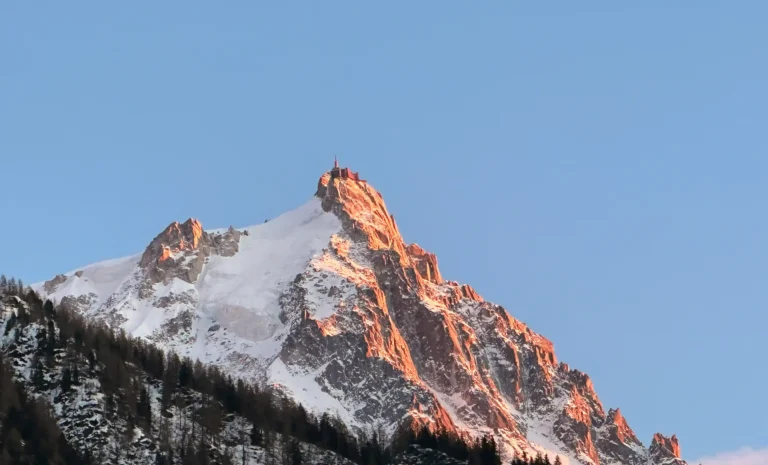
To reach the true highest point of the complex, you take an elevator bored straight through the solid rock of the Piton Central. It lifts you the final 65 meters to the narrow terrace beneath the iconic metal transmitter spire—the sharp needle you can see from the streets of Chamonix below.
From this upper deck, the crown of Mont Blanc (4,808 m) sits less than 1,000 vertical meters above you, close enough that you can spot tiny lines of climbers moving across the snow dome through the terrace binoculars.
This terrace is also home to Step Into the Void (Le Pas dans le Vide), a five-sided glass box suspended over a sheer 1,000-meter drop above the Bossons Glacier.
- What it’s actually like: Entry is included in your cable car ticket, though the queue regularly stretches from 30 to 60 minutes in peak summer. When you reach the front, you leave your bags aside, slip giant padded felt booties over your shoes to keep the three-layer glass scratch-free, and hand your phone or camera to the staff member on duty. Stepping out takes a genuine moment of nerve—looking straight down between your boots into a kilometer of empty space tricks your brain even when you know the glass can hold several tons.
Crossing the Glacier into Italy: The Panoramic Mont-Blanc Gondola
If you visit between late May and September and the winds are calm, you don’t have to turn around at the summit. From the Aiguille du Midi, you can board the Panoramic Mont-Blanc—a remarkable 5-kilometer gondola that floats across the French-Italian border to Pointe Helbronner (3,462 m) in Italy.
- The Ride: Unlike the massive cable car from Chamonix, this line uses tiny, four-person red cabins grouped in clusters of three. For about 30 minutes each way, you drift silently over the deep blue crevasses, towering ice seracs, and snowfields of the Glacier du Géant, which feeds into the legendary Mer de Glace.
- The Mid-Air Stops: Because the cabins travel in pulsed groups of three, whenever one cluster stops at a station to let passengers on or off, your cabin stops dead in mid-air over the glacier for a couple of minutes, swaying gently in the wind. If you have a fear of heights, this is far more intense than the main cable car.
- Cost & Documents: The round-trip add-on costs roughly €38 (and is not covered by the standard Mont Blanc Multipass). Because Pointe Helbronner connects to the Italian Skyway Monte Bianco down to Courmayeur, bring your passport or national ID card.
How Much Time Do You Need?
- Aiguille du Midi only: Budget 2.5 to 3 hours from the moment you board in Chamonix. During peak periods, your ticket assigns you a specific cabin number for the ascent and a suggested return window (usually around 90 minutes to 2 hours at the top) to prevent bottlenecks on the way down.
- With Step Into the Void: Add an extra 30 to 45 minutes to account for the lines at both the summit elevator and the glass box.
- With the Panoramic Mont-Blanc to Italy or a stop at Plan de l’Aiguille: Treat it as a half-day trip (4 to 5 hours).
Practical Tips Before You Go
- Check the live webcam, not the valley sky: Chamonix can feel sunny while the peak is swallowed in a thick cap cloud, or vice versa. Never buy a walk-up ticket without checking the live Aiguille du Midi summit webcam early in the morning. Paying €78 to stare at the inside of a grey cloud is a miserable way to spend a morning.
- Book the earliest morning slot in summer: In July and August, cabin timeslots often sell out a day or two in advance. Aim for a departure before 8:30 AM. Not only are the queues for the summit elevator and Step Into the Void much shorter, but afternoon heat often builds clouds around Mont Blanc after midday.
- Dress for mid-winter, even in August: Expect a temperature drop of around 20°C to 25°C compared to the valley floor, before factoring in wind chill. When it is 24°C and t-shirt weather in Chamonix, it is routinely below freezing (-3°C to -8°C) on the upper terraces. Bring a warm fleece or packable down jacket, a windproof outer shell, long pants, and closed-toe shoes.
- Don’t skip proper sunglasses and sunscreen: Between the thin atmosphere at 3,842 meters and the intense reflection bouncing off the surrounding glaciers, the UV radiation is fierce. Category 3 or 4 sunglasses are essential on sunny days.
- Do the math on the Mont Blanc Multipass: If you also plan to ride the Montenvers cog railway to the Mer de Glace or take the Brévent-Flégère lifts on another day of your trip, a 2-day or 3-day Mont Blanc Multipass costs barely more than a single Aiguille du Midi ticket and covers them all.
Related reading: